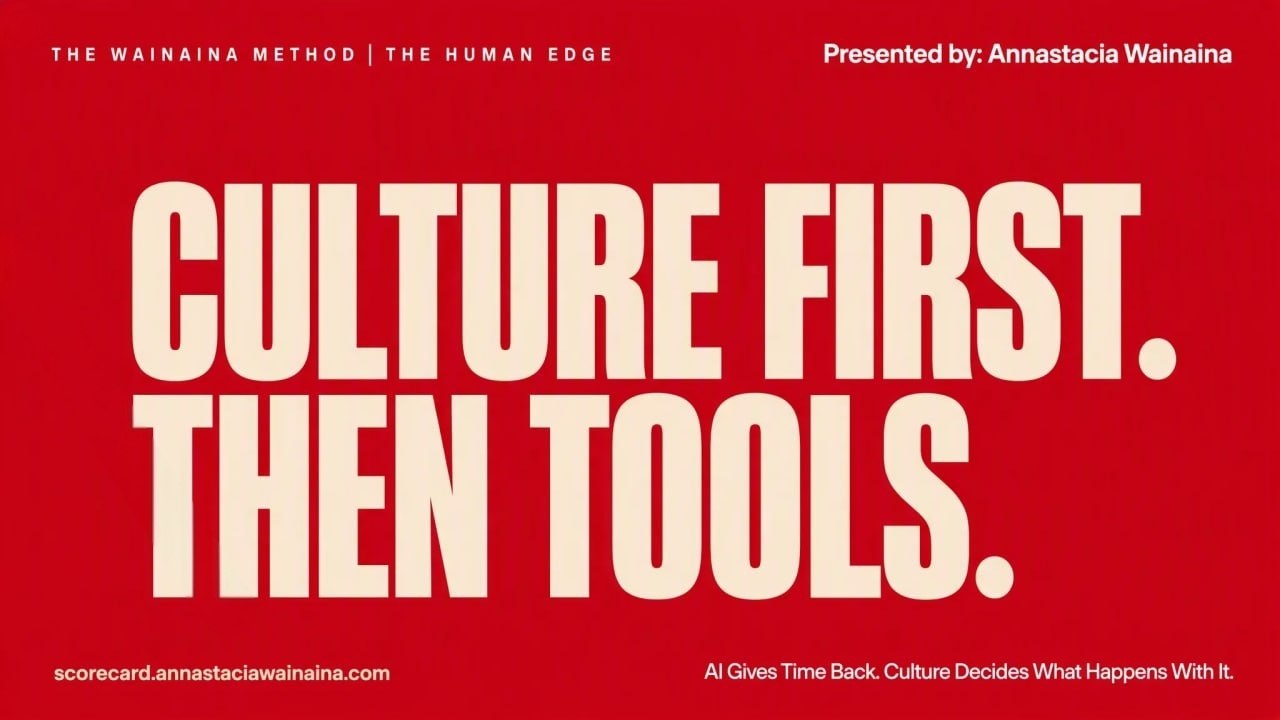
AI Gives Time Back. Culture Decides What Happens With It.
The Government's Bet
On Monday this week, Treasurer Jim Chalmers released Australia's 2026 Intergenerational Report. It projects the economy and the population to 2066. It names AI as the first and most significant of five major transitions Australia faces in that time.
The care dimension of that argument is stark. The number of Australians over 85 is expected to triple by 2065. The care workforce needs to grow substantially to meet that demand. And the report's plan for how AI helps with that pressure is specific: it is expected to handle routine administrative tasks and allow workers to spend more time with patients and care recipients.
That is a significant promise. It is the kind of promise that shapes investment decisions, budget allocations and strategy documents across the aged care and healthcare sector for the next decade.
So it is worth reading what the same report says, on page 15, about where that promise currently stands.
"While two-thirds of Australian businesses reported adopting AI in some form, fewer than 10 per cent described that adoption as significant. Australians' trust in AI is also low, which reduces willingness by workers, consumers and businesses to engage with AI technologies. This helps to explain why economy-wide impacts on measured productivity have been very modest so far, despite the rapid growth in AI-related investment."
The government's 40-year plan for care depends on AI. And the government's own analysis says the primary reason that plan is not yet producing results is trust.
Not technology. Not investment. Trust.
You cannot build AI productivity on a culture that has not first earned the trust that AI requires to work.
What the Nursing Survey Adds
The same week, a survey of 202 hospital nurses in the United States added something specific to that picture.
The nurses surveyed had all been exposed to AI or algorithmic systems in their workplace in the previous year. The findings were not about AI failures or technical errors. They were about what happened to human behaviour after AI arrived.
One in three reported being less willing to report a near miss after AI was deployed. Only 38 per cent felt safe to override or disagree with the system. Nearly two thirds said AI introduced new tasks without removing previous work. And 73 per cent said their leaders emphasised return on investment and throughput over nursing impact.
I want to be careful with this data. It is a US sample, 202 respondents, self-reported, and the researchers themselves are clear that it does not prove AI caused harm. It is a warning signal, not a finding of causation.
But the signal it is sending is one I recognise from clinical environments that had no AI at all.
The nurse who does not report the near miss is not being dishonest. She is being rational. She is responding to what the culture has already taught her about the cost of honesty. When a system watches, timestamps and flags, and the culture has not established that raising a concern is safe, people go quiet. They adapt their behaviour to avoid the flag rather than to improve the care.
In care settings, a near miss that is not reported is the closest thing we have to a guarantee that the next incident will be more serious. Reporting is not a bureaucratic function. It is how an organisation learns before something goes wrong rather than after.
AI does not silence nurses. Culture does. But AI, deployed into a low-trust culture, can make that silence move faster and be harder to see.
The Jobs AI Cannot Reach
The Intergenerational Report also contains a phrase that I think deserves more attention than it has received.
Citing economists who have studied AI and work, the report describes certain jobs as "bundles of judgement, coordination, accountability, tacit knowledge, and human relationships."
It then explicitly names aged and disability carers among the occupations least exposed to AI automation.
Read that carefully. In a document focused on AI as the primary economic transformation of the next 40 years, the work that carers do is named as the work AI cannot reach.
Not because carers are behind the technology curve. Because their skill is specifically and irreducibly human.
The relationship with a resident built across hundreds of small moments. The judgement that reads a person's face before they speak. The presence that makes someone feel genuinely seen in a place that is not their home. The knowledge that is not written in any file and cannot be transferred to any system, because it lives in the person who has shown up, consistently, for years.
These are not gaps in the care system waiting for AI to close them. They are the core product of the care system. And as AI handles the administrative, the routine and the repeatable, these human skills become the scarce, appreciating asset at the centre of the care economy.
The time AI gives back to carers is only worth something if the culture they work in knows how to use it.
Where to Invest First
The organisations I work with in aged care and healthcare are at the beginning of a decade of AI integration. The decisions being made now about tools, platforms and automation will shape the sector for a long time.
But the variable the Intergenerational Report names as the central obstacle to AI productivity is not which tool to choose. It is trust. And trust is not a technology investment. It is a culture investment.
So before the next AI budget line is approved, I want to ask the boards and CEOs in this sector three questions.
- What is the trust level in your organisation right now? Not what you hope it is. What the people on the floor would say if they could be honest without consequence.
- When AI gives time back to your carers, what does your culture tell them to do with it? Is there a shared understanding of what the deeply human work of care looks like, and do people have the safety and the skill to do it?
- Can the people closest to your residents raise a concern, override a system or report a near miss without it costing them something? Because if they cannot, the near miss the AI flags will be the one they find a workaround for. And the one it misses will be the next serious incident.
The Intergenerational Report is right that AI will transform care. The question for leaders is not whether that transformation is coming. It is whether the human conditions for that transformation have been built.
Culture first. Then tools. That is the human edge in the AI era.
Annastacia Wainaina is a Culture Strategist, Global Keynote Speaker and Host of The Human Edge Podcast. She works with boards and executive teams in aged care, healthcare, emergency services and complex people-heavy industries on the human conditions that make strategy, technology and culture change actually work.
Free AI-Readiness Human Skills Scorecard: scorecard.annastaciawainaina.com
Keynote and board facilitation enquiries: annastacia@annastaciawainaina.com
Sources: 2026 Intergenerational Report, Australian Treasury, released 21 September 2026 (p. 15, p. 16, p. 18, p. 21) · Black Book Research, State of AI in Hospital Nursing, released 23 September 2026 (202 US hospital nurses; self-reported; cross-sectional; researchers note findings do not establish causation of harm)
Is your leadership AI-ready?
Take the Free ScorecardAnnastacia Wainaina
Annastacia Wainaina is a culture strategist, global keynote speaker and host of The Human Edge Podcast. She works with CEOs, boards and executive teams in healthcare, aged care, emergency services and frontline operations.
Book an Executive Culture Diagnostic CallThe Human Edge Briefing
A weekly case study and insight for leaders who treat culture as strategy.
Comments (0)
Be the first to leave a comment!
Leave a Comment